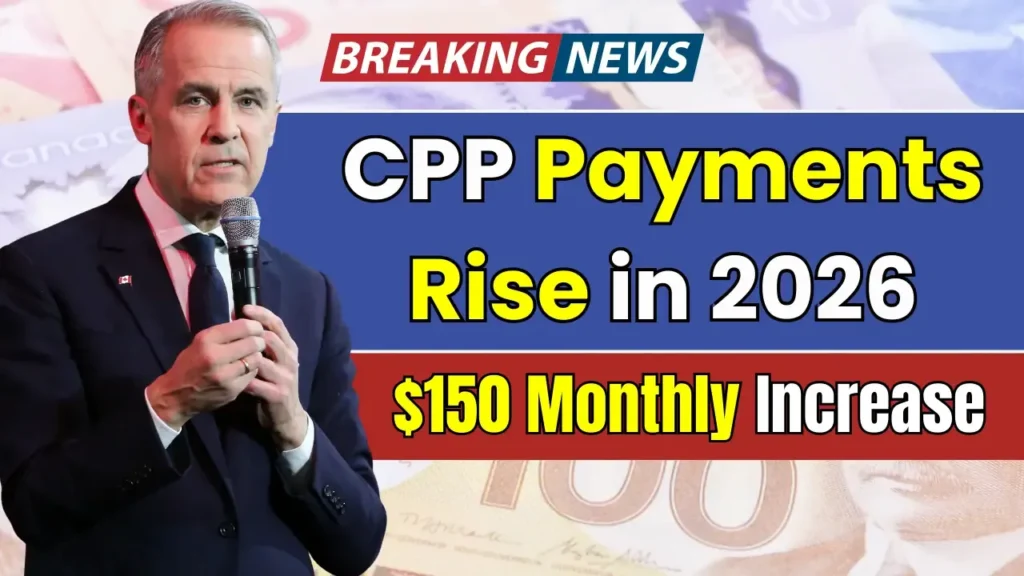
Canada Pension Plan (CPP) payments are increasing in January 2026, bringing higher monthly income for millions of retirees, people with disabilities, and surviving spouses across Canada. These changes are part of the ongoing CPP enhancement program and annual inflation adjustments designed to protect retirement income as living costs continue to rise.
While headlines mention increases of up to $150 per month, the actual amount depends on your work history, contribution level, and the year you started receiving CPP. Below is a clear, detailed breakdown of what is changing, who benefits most, and how the 2026 CPP update affects your financial planning.
Overview of CPP Payment Changes Starting January 2026
The Canada Pension Plan is a contributory public pension program funded by employees, employers, and self-employed Canadians. More than 7 million people receive CPP benefits each month.
For January 2026, CPP payments are adjusted mainly due to two factors:
- Annual inflation indexing based on the Consumer Price Index (CPI)
- CPP enhancement (CPP2), which increases benefits for those who contributed under the enhanced rules introduced after 2019
The maximum monthly CPP retirement pension at age 65 increases from approximately $1,364 in 2025 to about $1,433 in 2026. This reflects inflation protection rather than a flat increase for all recipients.
Who Can See the Largest CPP Increase in 2026?
The widely discussed “up to $150 monthly increase” applies mainly to:
- New retirees who began receiving CPP after 2023
- Workers with long contribution histories at or near the maximum earnings level
- Individuals who contributed under the enhanced CPP rates since 2019
Most long-term retirees will see more modest increases tied to inflation, typically between $40 and $70 per month. The enhanced portion grows gradually and becomes more significant for younger workers retiring in future decades.
CPP Maximum Monthly Payments for 2026
| Benefit Type | 2025 Maximum | 2026 Maximum | Estimated Increase |
|---|---|---|---|
| Retirement Pension (Age 65) | $1,364 | $1,433 | $69 |
| Post-Retirement Benefit | $45.00 | $47.74 | $2.74 |
| Disability Pension | $1,019 | $1,066 | $47 |
| Survivor Pension (Under 65) | $1,106 | $1,169 | $63 |
| Survivor Pension (65+) | $772 | $810 | $38 |
| Death Benefit (One-Time) | $2,500 | $2,625 | $125 |
Actual payments vary depending on your lifetime earnings and contribution history. Not all recipients qualify for the maximum amount.
Why CPP Payments Are Rising in 2026
The CPP increase reflects rising inflation and structural improvements to the pension system. Key drivers include:
- Inflation protection: CPP is indexed annually to preserve purchasing power
- Enhanced contribution rates: Gradual increases in CPP contributions since 2019
- Higher pensionable earnings ceiling: The Year’s Maximum Pensionable Earnings (YMPE) rises to about $75,200 in 2026
These adjustments aim to strengthen retirement security without relying on general tax revenue.
CPP Eligibility Rules You Should Know
To qualify for CPP retirement benefits:
- You must have made at least one valid CPP contribution
- You can start CPP as early as age 60 or as late as age 70
- Taking CPP before 65 permanently reduces your payment
- Delaying CPP after 65 permanently increases your payment
Disability and survivor benefits have additional medical and relationship requirements. CPP is not income-tested, meaning your income level does not affect eligibility.
How to Estimate Your Personal CPP Increase
Your personal CPP payment depends on:
- Total years worked and contributed
- Average earnings relative to the pensionable maximum
- Age when you start receiving CPP
- Years contributed under enhanced CPP rules
Many retirees in 2026 can expect monthly payments between $900 and $1,200, depending on their history. Enhanced CPP may add anywhere from $20 to $150 over time.
Do You Need to Apply to Get the 2026 Increase?
No action is required for existing CPP recipients. Payment increases are applied automatically each January.
New applicants can apply online through Service Canada up to 11 months before their intended start date. Direct deposit is recommended to avoid delays.
CPP Payment Dates for January 2026
CPP payments are typically issued during the last week of each month. The January 2026 payment reflects the new rates immediately and is usually deposited between the 22nd and 25th.
Electronic payments are faster and more reliable than mailed cheques.
How CPP Works with OAS and GIS
CPP forms the foundation of retirement income for many Canadians and works alongside:
- Old Age Security (OAS)
- Guaranteed Income Supplement (GIS) for low-income seniors
When combined, these programs help provide stable monthly income in retirement, though eligibility rules differ for each benefit.
Long-Term Impact of CPP Enhancements
The full impact of CPP enhancements will be felt over several decades. Younger workers who contribute under the enhanced system for their entire careers are expected to receive significantly higher retirement benefits than previous generations.
For now, the 2026 increase represents another step toward maintaining purchasing power and improving long-term retirement security for Canadians.
Final Thoughts on CPP Payments in 2026
The CPP payment increase in January 2026 is a meaningful adjustment that reflects both inflation and long-term pension improvements. While not everyone will see a $150 boost, most recipients will benefit from higher monthly income and better protection against rising costs.
Understanding how CPP works — and how your contributions affect your future payments — remains one of the most important parts of retirement planning in Canada.

My name is Arsam, and I am the founder and author of Mymct. I created this website to share reliable mobile technology updates and important news in a simple and easy-to-understand way. I have a strong interest in smartphones, mobile apps, and the fast-changing digital world, and I enjoy researching topics that are useful for everyday users.