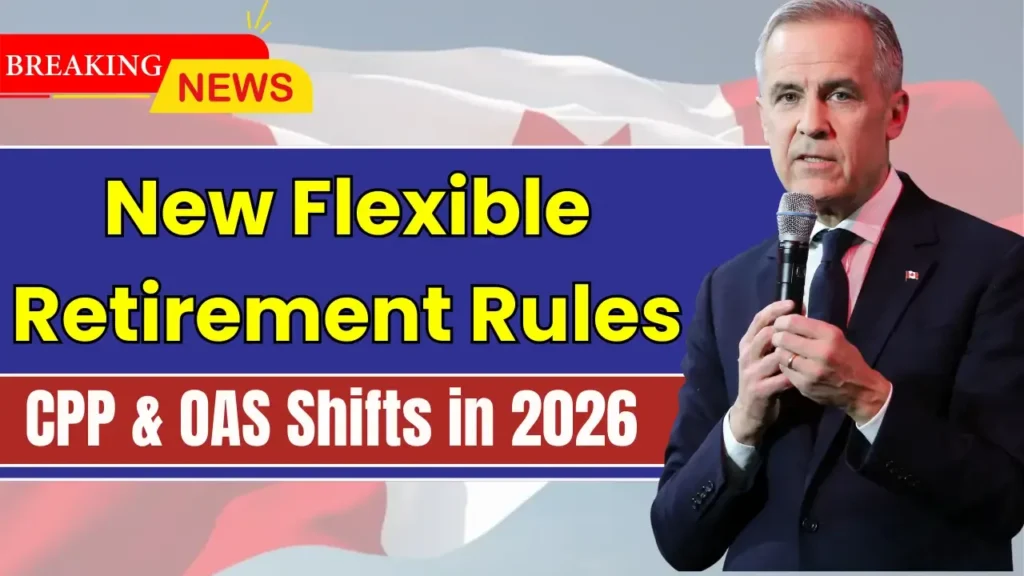
Canada is entering 2026 with meaningful adjustments to how retirement income works, particularly around the Canada Pension Plan (CPP) and Old Age Security (OAS). These updates are not sudden benefit giveaways or guaranteed income boosts. Instead, they focus on flexibility, longer participation, and gradual income planning for seniors who continue working or choose to delay retirement benefits.
With living costs remaining elevated and more Canadians working beyond traditional retirement age, these rule refinements are designed to reflect modern retirement patterns rather than push a one-size-fits-all outcome.
Why Retirement Flexibility Matters More in 2026
Retirement in Canada no longer follows a fixed timeline. Many seniors now work part-time, consult, or phase into retirement gradually. According to government labour data, participation among Canadians aged 65 to 69 has steadily increased over the past decade.
The 2026 adjustments aim to support this reality by aligning pension rules with longer careers, mixed income sources, and varied retirement goals. Importantly, these changes do not remove existing protections for low-income seniors or alter guaranteed indexing tied to inflation.
CPP Enhancement Completion and What It Changes
The long-planned CPP enhancement reaches full maturity in 2026. This enhancement gradually increased contribution rates and future benefit calculations over several years. Once fully implemented, eligible retirees may receive a higher percentage of their career-average earnings compared to pre-enhancement rules.
Key points include:
• CPP is designed to replace a larger share of employment income for future retirees
• Annual pensionable earnings limits continue to adjust with wages
• Benefits remain fully indexed to inflation
It is important to note that actual CPP payments still depend on individual contribution history, earnings consistency, and retirement age.
CPP Deferral Rules: What Has and Has Not Changed
CPP already allows benefits to begin as early as age 60 or be delayed until age 70. Starting earlier results in a permanent reduction, while delaying increases monthly payments.
What matters most in 2026 is not a new deferral age, but greater awareness and use of existing flexibility. Seniors can still:
• Start CPP at any month between 60 and 70
• Receive higher monthly payments by delaying
• Combine CPP with employment income
No automatic pension increases are triggered without deliberate deferral decisions. Service Canada continues to calculate adjustments based on established formulas.
Post-Retirement Benefits (PRB) and Working After 65
One of the most practical aspects of CPP is the Post-Retirement Benefit (PRB). Seniors who receive CPP and continue working may generate additional CPP income through ongoing contributions, depending on age and earnings.
In general terms:
• Working CPP recipients aged 65 to 70 may contribute
• Contributions create small, permanent PRB increases
• PRBs are paid on top of regular CPP
These additions are modest on a monthly basis but can improve long-term income stability. Contributions stop automatically at age 70, even if employment continues.
Old Age Security (OAS) Deferral Remains an Option
OAS remains a separate program from CPP and is funded through general tax revenue. Eligible Canadians can still choose to delay OAS beyond age 65, increasing monthly payments up to a defined maximum.
Important facts to understand:
• OAS is indexed quarterly to inflation
• Delaying OAS increases monthly payments permanently
• OAS recovery tax (clawback) still applies to higher incomes
There is no requirement to defer OAS, and for many seniors with modest incomes, early access may remain the more practical choice.
How Income Thresholds and Clawbacks Still Apply
OAS recovery thresholds continue to adjust annually. Seniors with higher net incomes may repay part or all of their OAS through the tax system. These rules have not been removed in 2026.
However, careful planning — such as income splitting, RRSP drawdown timing, and pension sharing — can help manage taxable income without violating program rules.
What These Changes Mean for Couples and Families
Retirement planning increasingly involves household strategies rather than individual decisions. Couples often coordinate when to start CPP or OAS to balance cash flow, survivor income, and tax exposure.
Common planning approaches include:
• One partner claiming earlier for stability
• The other delaying for higher lifetime income
• Using pension income splitting where eligible
These approaches do not guarantee higher total income but may improve predictability and long-term security.
Impact on Seniors Who Continue Working
The updated framework supports seniors who want or need to remain in the workforce. It does not force continued employment, nor does it penalize those who stop working earlier.
For working seniors, the system:
• Allows continued CPP participation up to age 70
• Preserves access to inflation-indexed benefits
• Recognizes partial or phased retirement patterns
This flexibility is particularly relevant in healthcare, education, and skilled trades where experience remains valuable.
Planning Carefully Under the 2026 Rules
Despite improved flexibility, there are no universal outcomes. Health, life expectancy, employment stability, and personal finances all influence whether delaying or continuing to work makes sense.
Reliable planning steps include:
• Reviewing Service Canada benefit estimates
• Understanding tax impacts before deferring benefits
• Avoiding assumptions about maximum payouts
Professional financial advice remains helpful, especially for households managing multiple income sources.
The Bottom Line for Canadian Seniors in 2026
The 2026 CPP and OAS environment does not promise automatic pension increases or guaranteed wealth in retirement. Instead, it provides more control over timing, contributions, and coordination for those who want flexibility.
For many Canadians, the real value lies in having options — whether that means working longer, retiring earlier, or balancing both. Understanding the rules clearly is the most reliable way to make informed decisions under Canada’s evolving retirement system.

My name is Arsam, and I am the founder and author of Mymct. I created this website to share reliable mobile technology updates and important news in a simple and easy-to-understand way. I have a strong interest in smartphones, mobile apps, and the fast-changing digital world, and I enjoy researching topics that are useful for everyday users.